Foambid logoFoambid Pro
In development
For spray polyurethane foam contractors

Estimating software that knows how foam actually behaves.

Built by a contractor who sprays it. Foambid Pro covers the whole job — not just the estimate — in one system that speaks the trade’s own language: board feet, sets, lifts, and yield.
Takeoff Bid Proposal Field capture Reconciliation Payroll
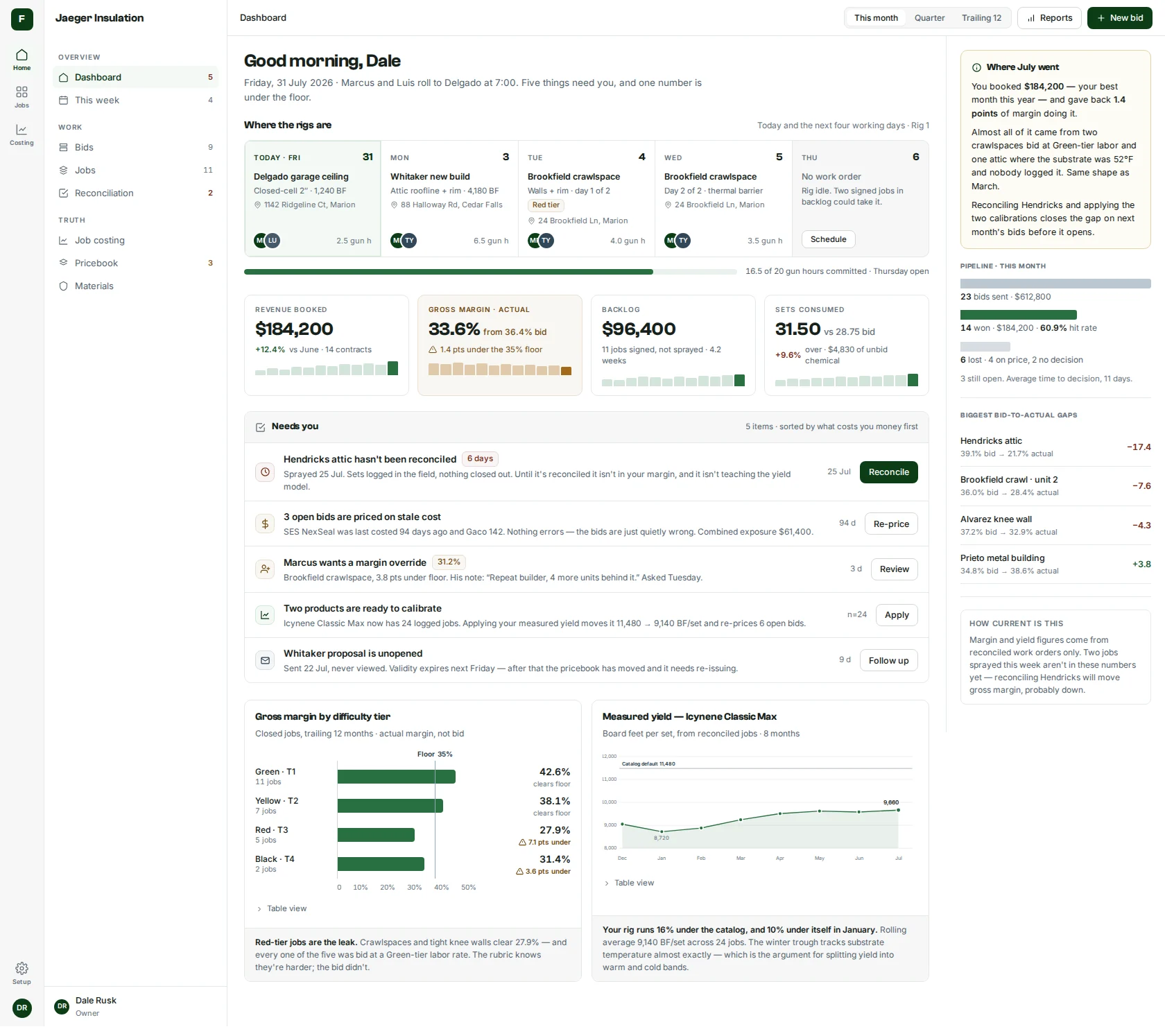
Foambid Pro owner dashboard: rig schedule for the week, revenue and margin figures, a prioritized list of items needing attention, and gross margin by difficulty tier.
The owner dashboard. All screens on this page show a demonstration shop — sample data throughout. Click any screen to zoom.
The differentiator

It models passes, not just thickness.

Foam goes on in lifts, and every product has a max lift — the most it can safely be sprayed in one pass. That single fact changes the chemical, the schedule, and the price. Software that only knows square footage can’t see any of it.

Same wall. Two products. Different jobs.

A closed-cell product rated for 2″ per pass needs three passes to fill a 5.5″ wall. One rated for 4″ needs two. Passes cost chemical — the first inch of every pass yields worse — and a third pass often waits until tomorrow, which turns a one-day job into a two-day job with a second day of rig time and overhead.

Foambid Pro prices all of it: the lift plan, the extra chemical, and the extra spray day — from each product’s own max lift and cure behavior.
Product A · 2″ max lift
5.5″ wall · three passes
Pass 3 · 1.5″day two
waits for cure — often overnight
Pass 2 · 2.0″onto foam
Pass 1 · 2.0″on substrate
Two spray days. More chemical to the same R-value. The bid should know that before the customer does.
Product B · 4″ max lift
5.5″ wall · two passes
Pass 2 · 1.5″onto foam
Pass 1 · 4.0″on substrate
One spray day. Same wall, different product, genuinely different job — and a genuinely different bid.
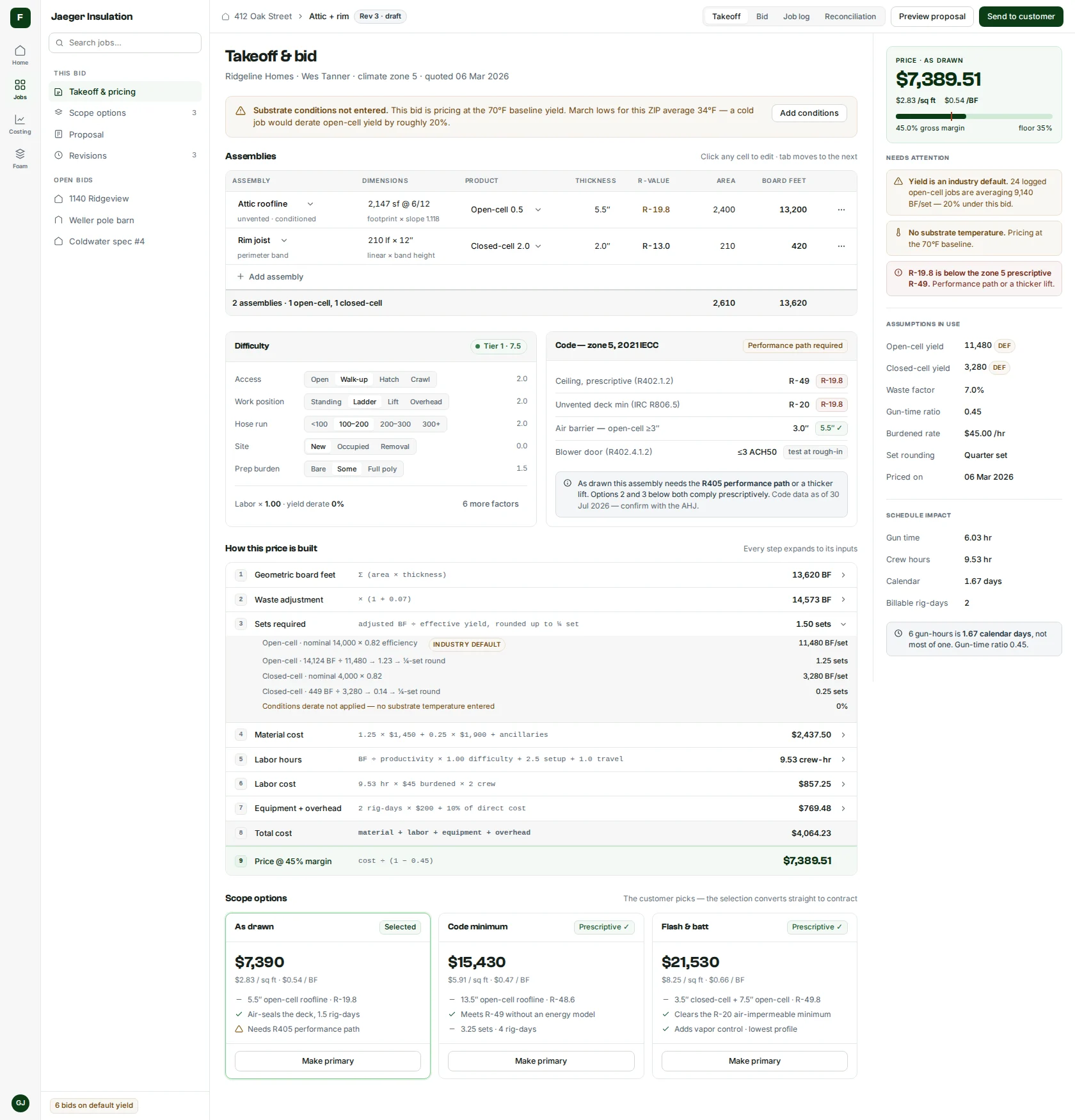
Foambid Pro bid builder: assemblies with dimensions, products and thickness, difficulty scoring, code panel, and the step-by-step price build.
The bid builder — every step of the price expands to its inputs.Sample data
The catalog

Every number knows where it came from.

The pricebook ships with real products imported from manufacturers’ published technical data sheets — densities, yields, max lifts, R-values. And every field carries its provenance: a manufacturer’s published figure, an industry operating default, or an estimate. A number that can’t be traced is labeled as such — never quietly presented as fact.
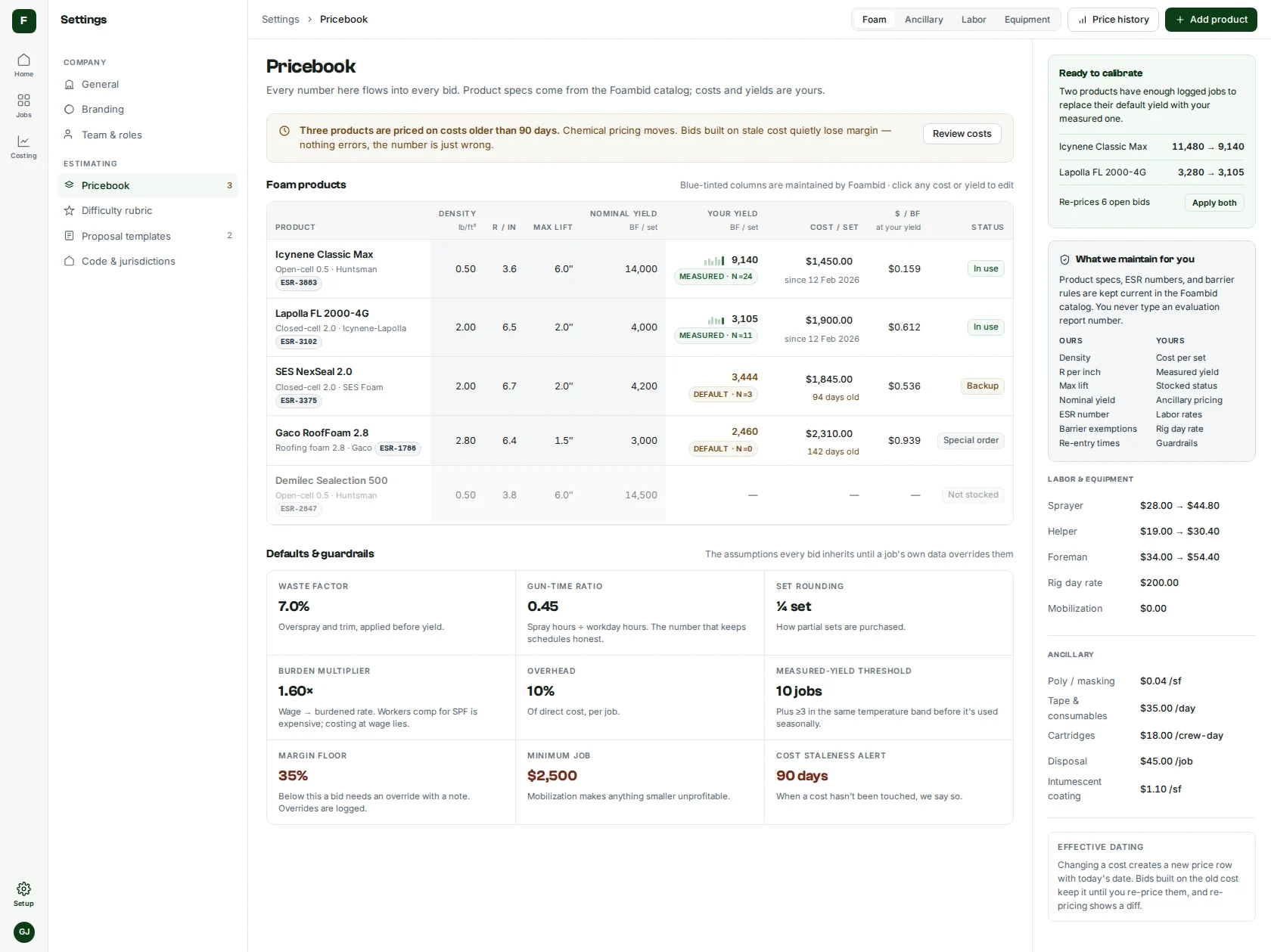
Foambid Pro pricebook: foam products with specifications from manufacturer technical data sheets, costs and yields, each figure carrying a provenance label.
Manufacturer figure Industry default Estimate — labeled as such
Sample data
260
real products in the catalog
74
manufacturers, from published data sheets
3
provenance labels — every field wears one

Catalog data comes from publicly published technical data sheets. It does not imply any manufacturer partnership or endorsement.

Proposals

Code paths and options, right in the estimate.

The proposal your customer receives can carry real choices — scope options priced side by side, the code path named, thermal and ignition barriers as honest line items rather than surprises. Templates are fully editable, and the same bid can speak homeowner or builder.
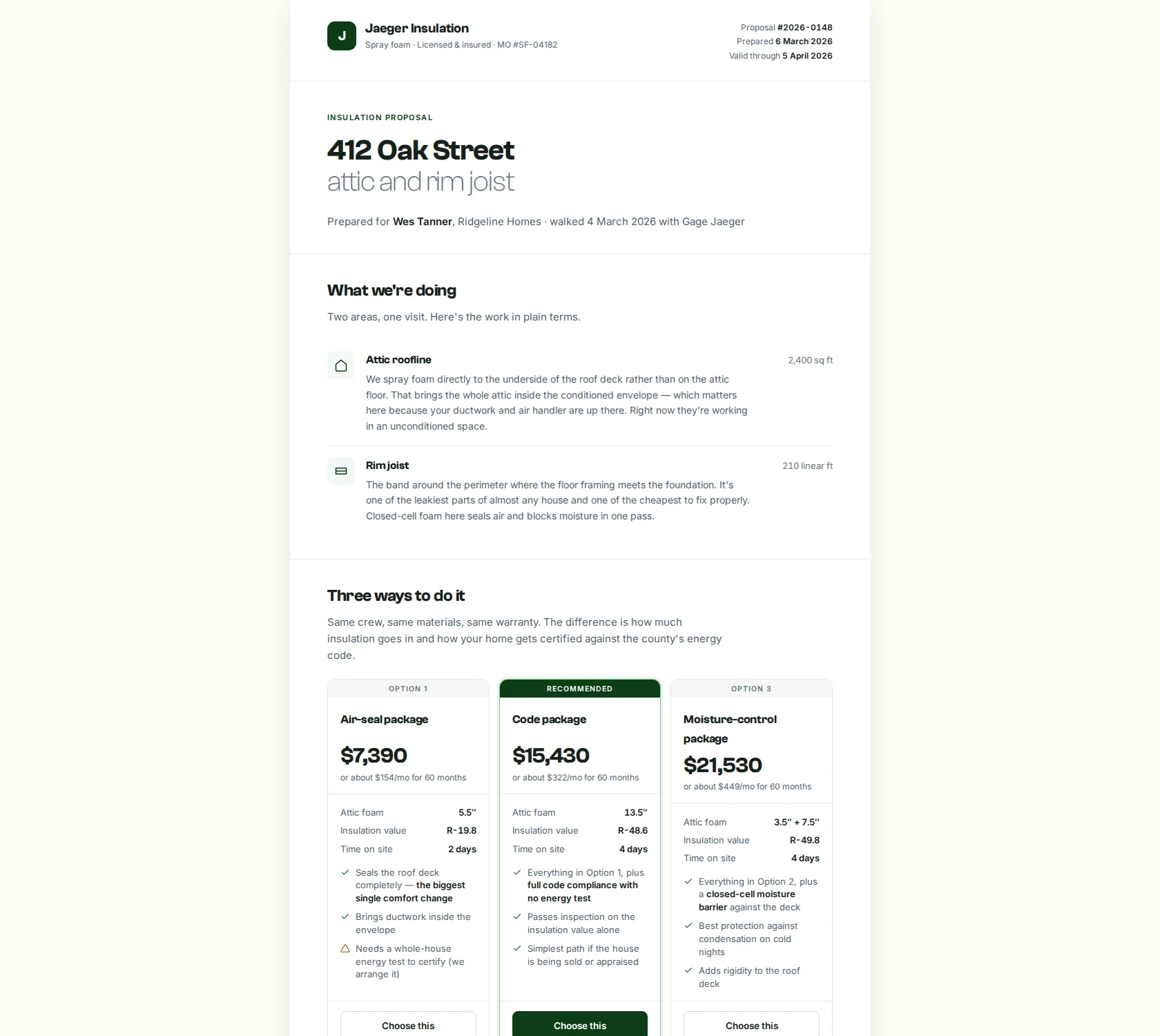
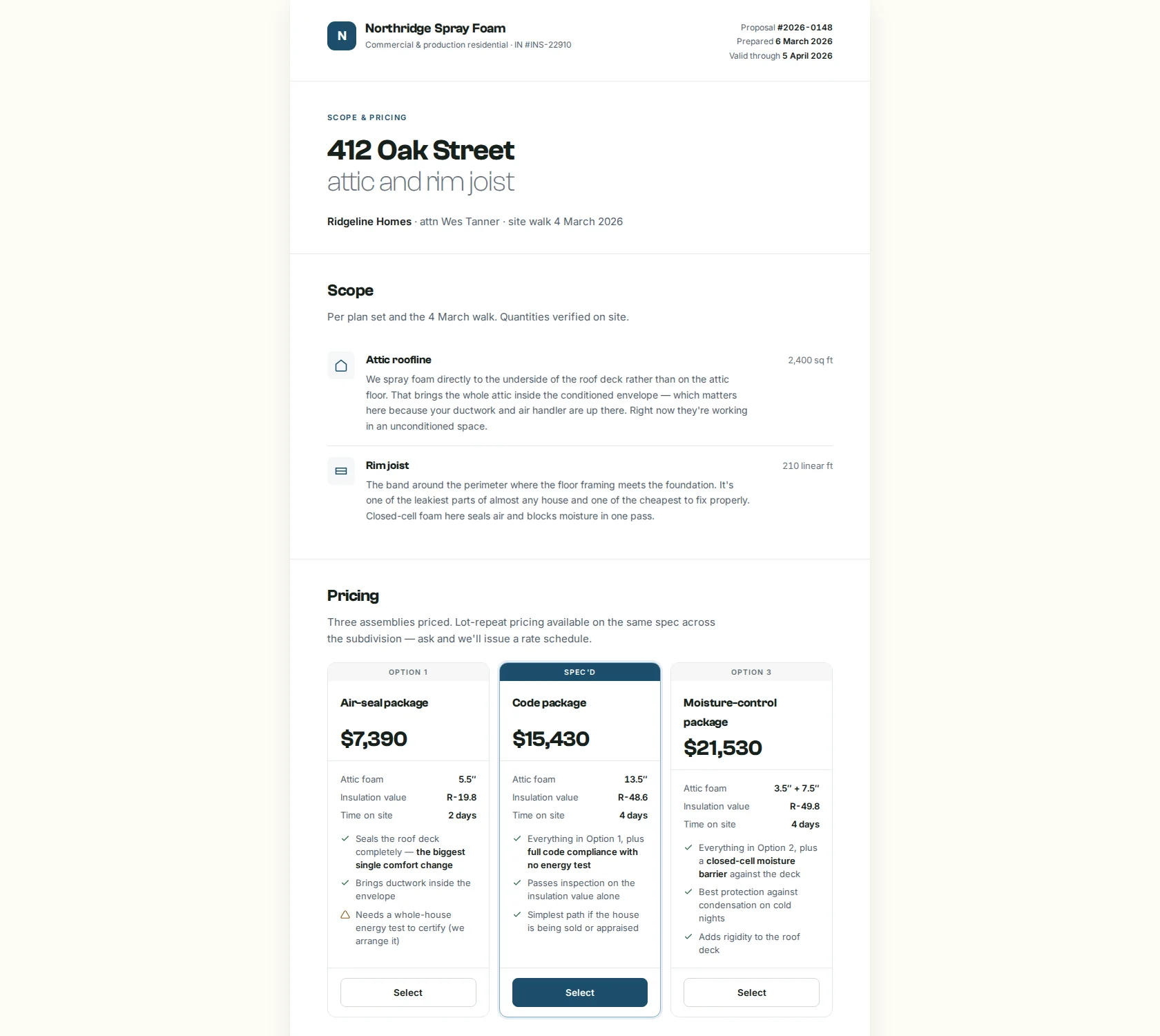
Foambid Pro customer proposal: homeowner-language document generated from the bid, with scope, options, and code path stated.
The customer proposal — generated from the bid, options included.Sample data
Foambid Pro builder proposal variant: the same bid re-spoken for a builder, with assembly specifications and code path.
The builder variant — same numbers, different audience.Sample data

The software names the compliance path and attaches the documentation. It never declares that an assembly passes — that verdict belongs to the inspector, and a tool that pretends otherwise puts the contractor’s name at risk.

Sprayer-side

The job rides along. The truth comes back.

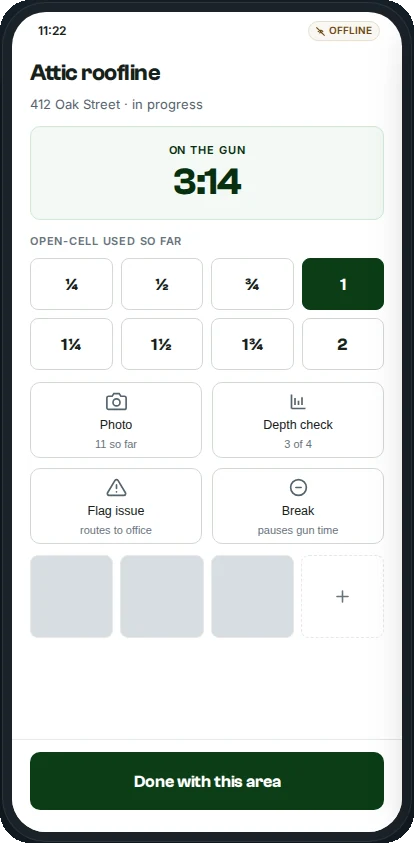
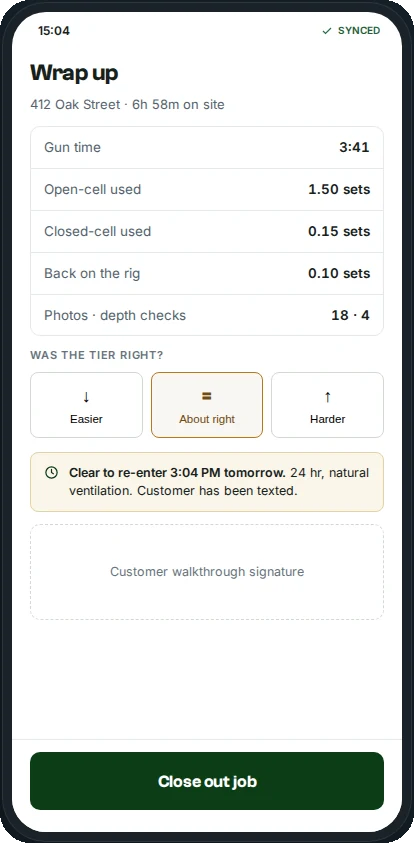
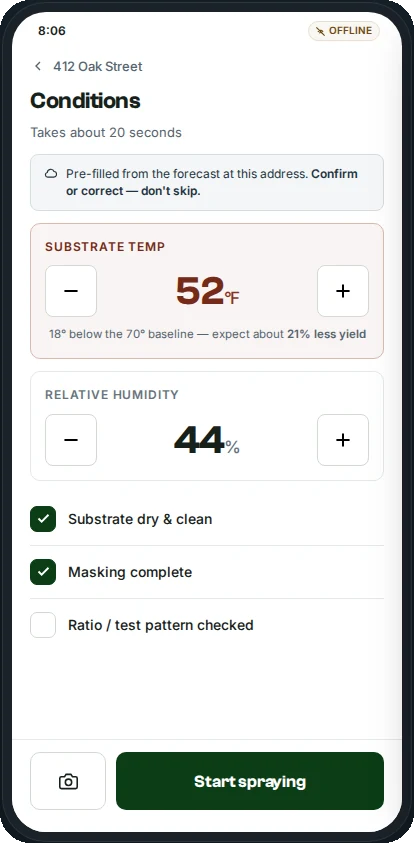
Job details travel with the crew — scope, product, thickness, what the office assumed. Conditions get confirmed on arrival, sets get logged in quarters the way crews actually think, and the post-job entry closes it out: material used, photos, depth checks, and how the job really went. Built for gloves, built for no signal.
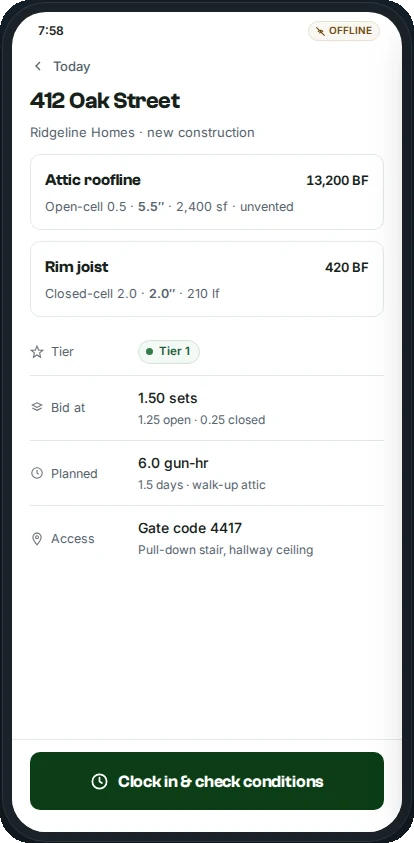
Field app job brief: the job's scope, products, thickness, and planned sets, readable from the cab.
Job brief
Field app arrival check: substrate temperature and humidity pre-filled from the forecast, confirmed on site, with a pre-spray checklist.
Arrival check
Field app spraying screen: gun timer, quarter-set picker, photo and depth check capture.
Spraying
Field app wrap-up: post-job entry with final material used, photos, depth checks, and tier feedback.
Post-job entry

The field app works offline and syncs when the truck finds signal. Sample data throughout.

Difficulty tiers

A crawlspace doesn’t bid like an open warehouse.

Every job gets scored — access, hose run, prep burden, conditions — into a tier from Green to Black. The tier carries through the whole system: labor multipliers and yield derates in the price, honest time on the schedule, and a scale for crew performance plans.

Tier 1 · Green

Walk-in access, short hose, empty building. The job the rest get measured against.

Tier 2 · Yellow

Occupied space, real masking, a longer pull. Same gun time — slower everything else.

Tier 3 · Red

Tight crawls, long hose runs, winter schedules. Productivity drops and yield follows.

Tier 4 · Black

Lifts, night work, hostile logistics. Fine work — if the bid admits what it is.

A shop that bids everything at Green wins the brutal jobs at a loss without knowing it. The rubric knows they’re harder; the tier makes sure the bid does too.

Reconciliation & traceability

Every number can be re-derived a year later.

When the work order closes, reconciliation lays the bid against what actually happened — material, hours, conditions — so the gap has an explanation instead of a shrug.

And because bids record how every input was resolved — which pricebook version, which yield figure, which difficulty rubric — you can pull up a job from last spring and reconstruct exactly why it priced the way it did. That matters for disputes, for change orders, and for finding out why a job lost money.
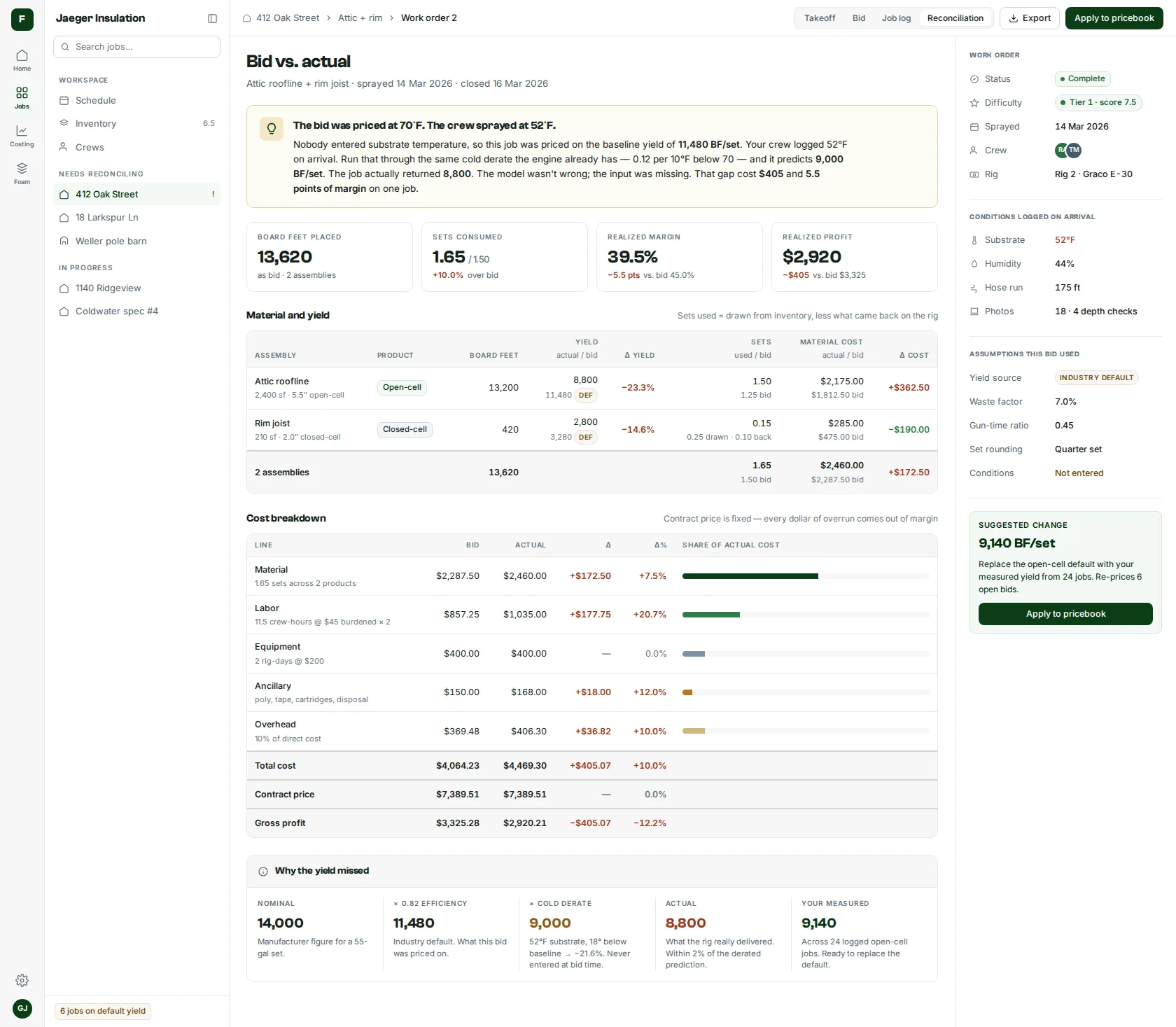
  • Bid vs. actual, line by line, per work order
  • Conditions from the field become the explanation, not an excuse
  • An append-only audit trail — estimates are versioned, never quietly edited
Foambid Pro reconciliation screen: bid versus actual comparison with material and yield detail and the conditions the job ran under.
Reconciliation — the screen the whole system feeds.Sample data
Crew & pay

Performance pay, designed to be earned fairly.

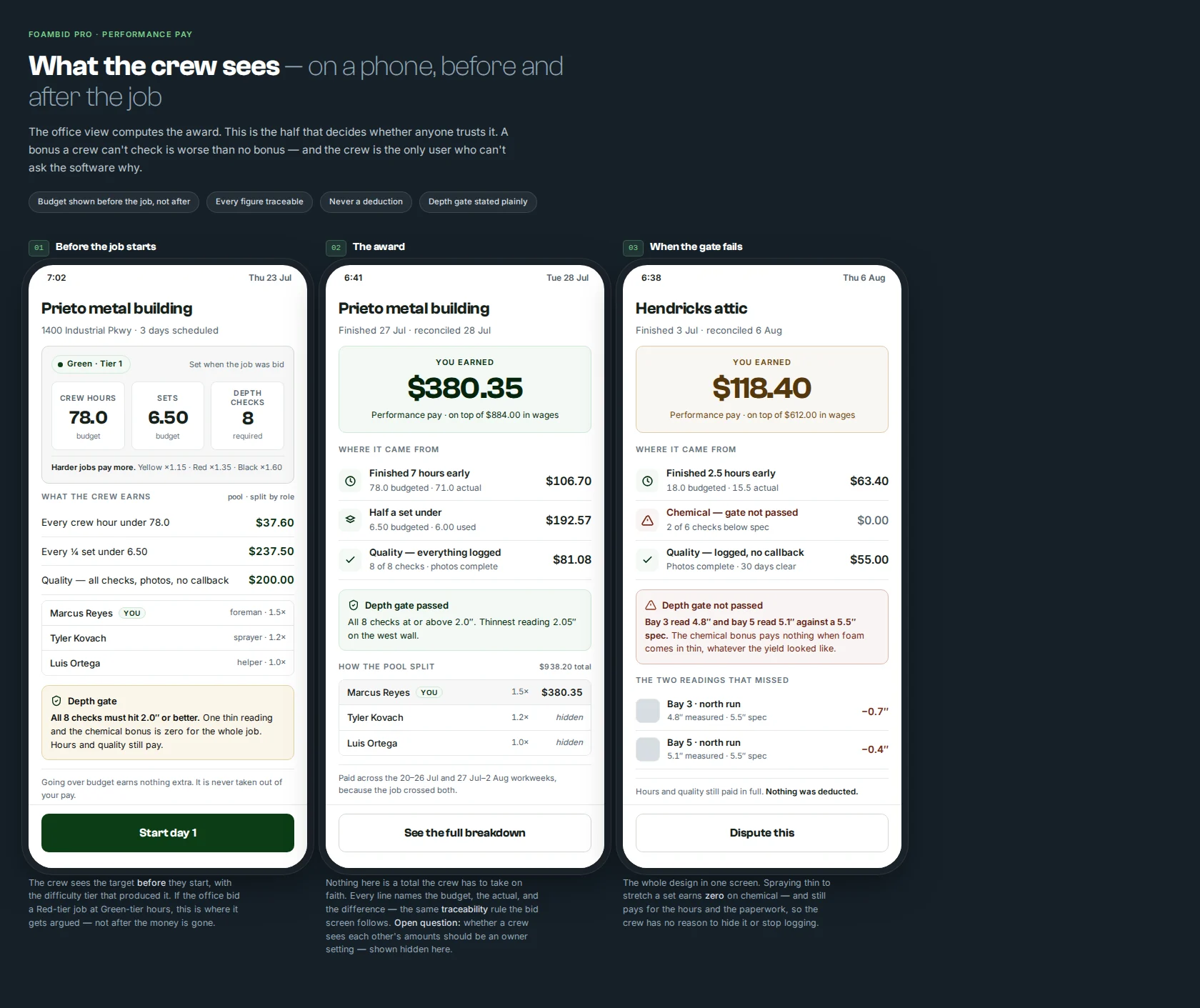
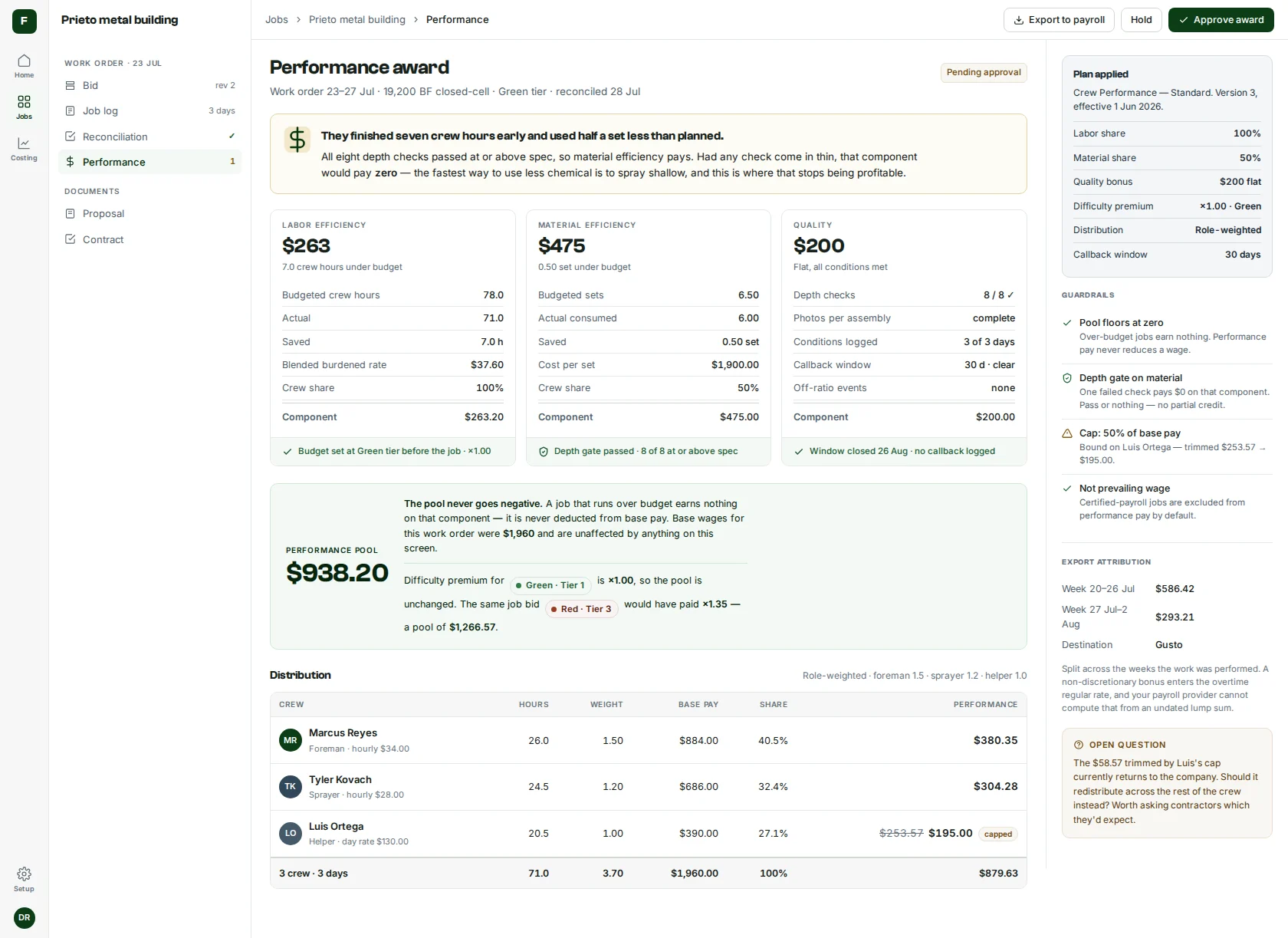
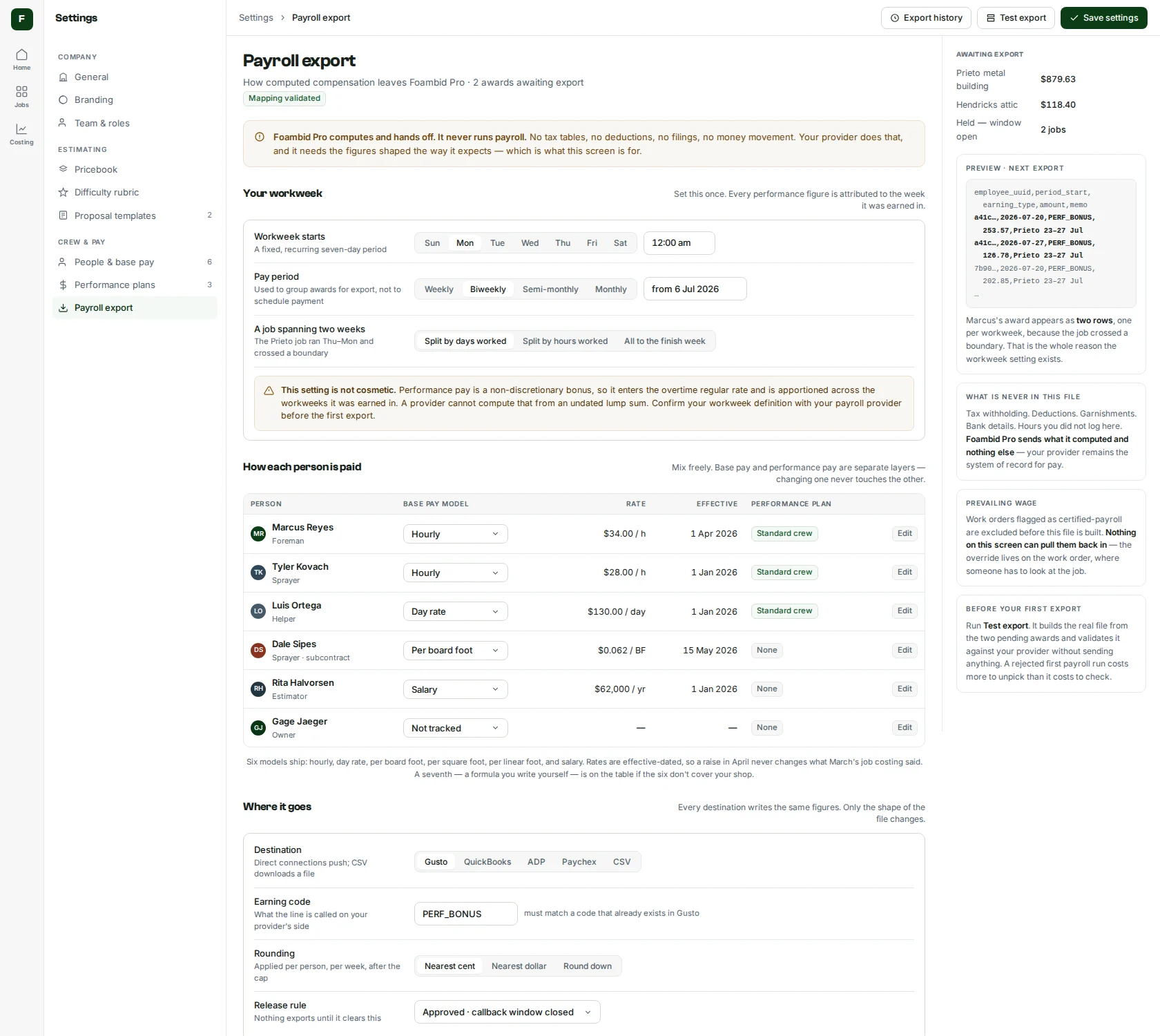
Pay plans built on the same data the rest of the system runs on: labor efficiency against the difficulty-adjusted budget, material efficiency gated on depth checks, scaled by tier — so the hard jobs are worth spraying well. Payroll export shapes the figures for your provider; Foambid Pro computes and hands off, it never runs payroll.

Design preview — in design, not yet shipping
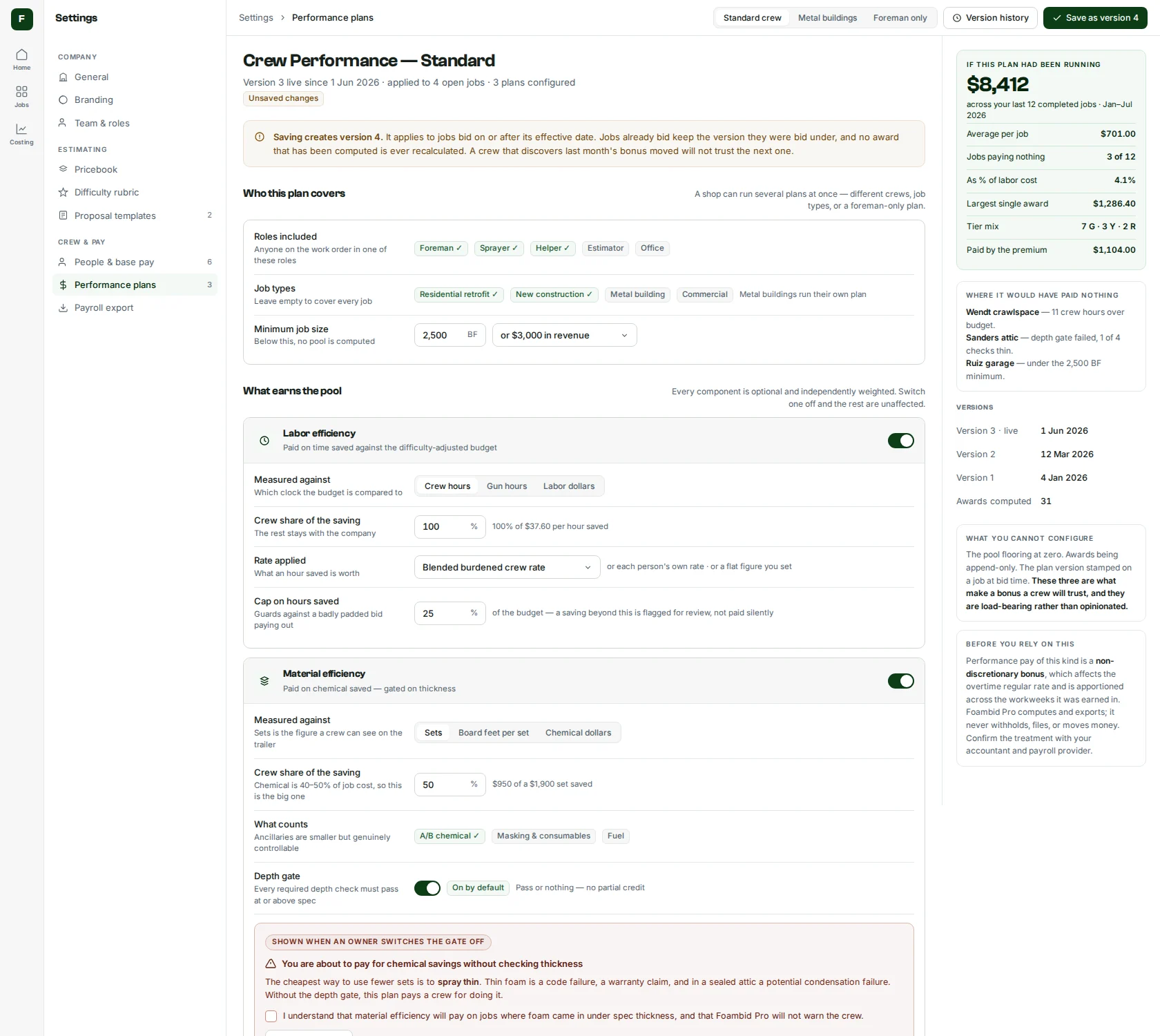
Foambid Pro performance plans design mockup: configurable pay plan with labor efficiency and material efficiency components, crew share percentages, and a depth-check gate.
Performance plans — every component optional and weighted per shop.Design preview
Foambid Pro payroll export design mockup: workweek definition, per-person base pay models, and export destinations for a payroll provider.
Payroll export — computed figures, handed to your provider.Design preview
Foambid Pro crew performance design mockup: per-sprayer view of performance across jobs.
The crew’s view — what was earned, and from which jobs.Design preview
Foambid Pro performance award design mockup: a single job's award breakdown showing how the bonus was computed.
One job’s award — the math shown, not asserted.Design preview
Customization

Runs the way you run.

No two foam shops price, propose, or pay the same way — and most software punishes them for it. In Foambid Pro the defaults are starting points, not rules:

  • Pricebook values — your costs, your labor rates, your rounding rules
  • Difficulty rubric — score what actually makes your jobs hard
  • Proposal templates — every word your customer reads, editable
  • Pay plan design — components, weights, and gates, per shop Design preview

Owner-defined, organization-scoped, and versioned — so a setting changed in April never rewrites what March’s jobs said.
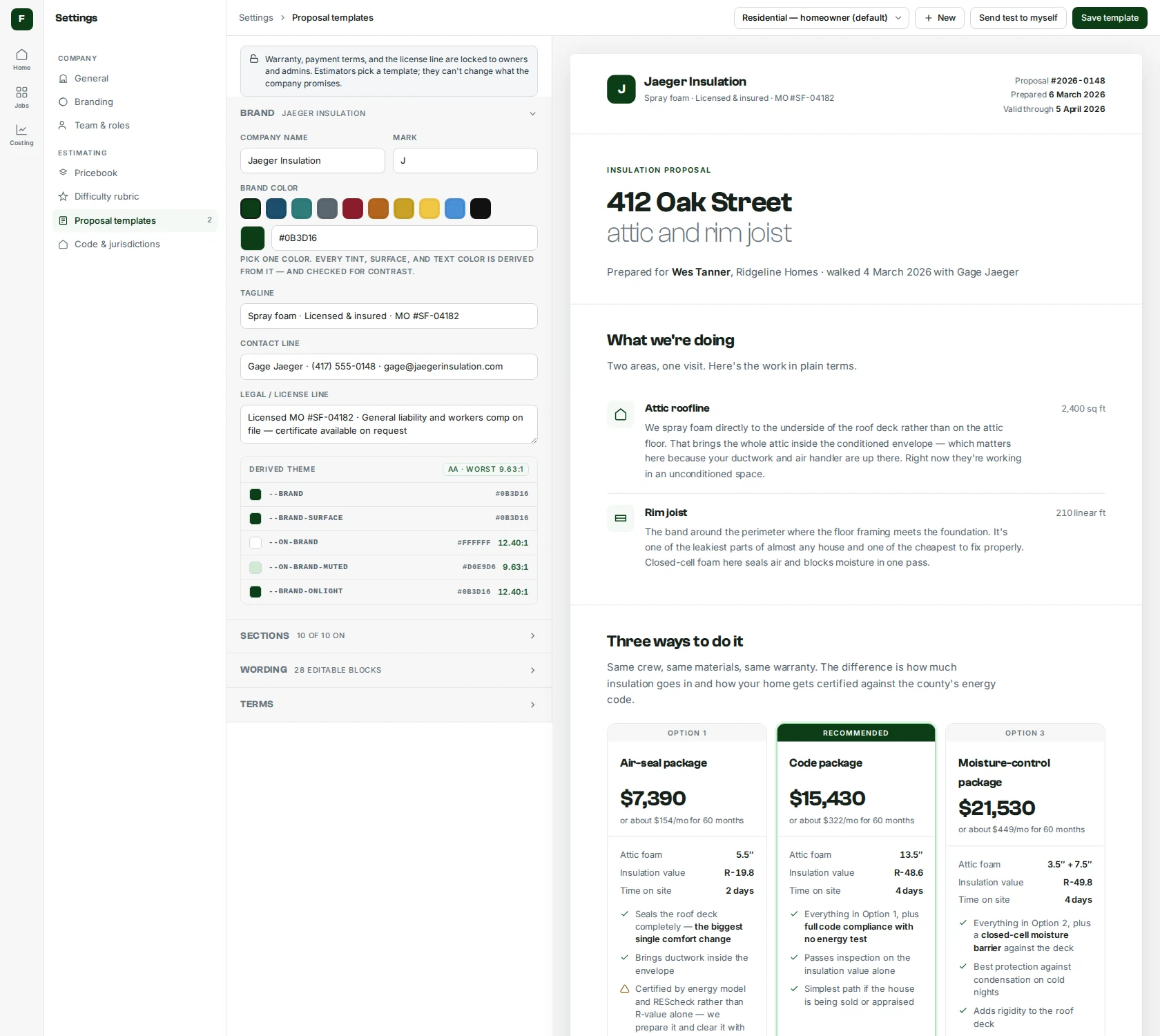
Foambid Pro proposal template editor: the customer-facing document's sections and language, editable per shop.
The template editor — the customer’s document, under your control.Sample data
Who’s building it

From a rig in Kearney, Nebraska.

Foambid Pro is built by Gage Jaeger, a working spray foam contractor. He already ships Foambid — the SPF estimating app live today on iOS and Android at $39.99/month — because he needed it and nobody else had built it.

Pro is the same instinct pointed at the whole business. The quarter-set picker, the pass logic, the provenance labels — none of it came from a product manager’s guess. It came from bidding jobs at night and spraying them the next morning.

“Every estimating tool tells you what the job should cost. I wanted the one that tells you what it did cost — and refuses to let the next bid forget it.”
Gage Jaeger · founder — still sprays